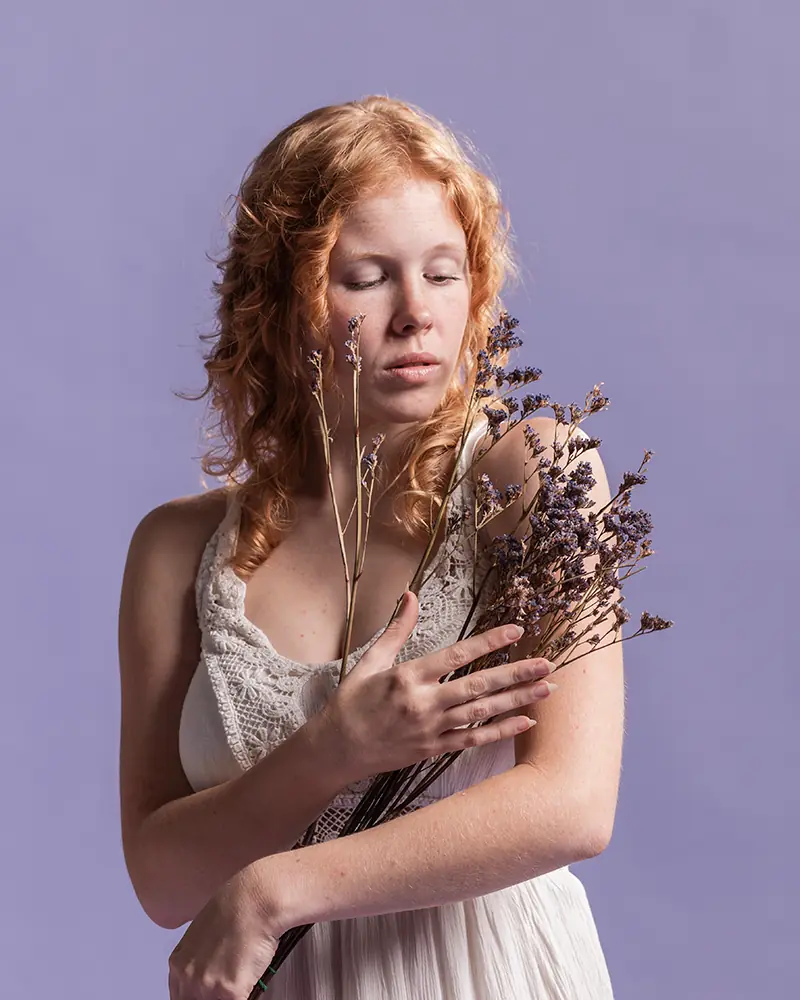
Fertility Herbs for Women: Womb Magic & Old European Folklore
Fertility magic has always lived in the oldest layers of European witchcraft. Long before midwives wrote recipes or monasteries collected herbals, women carried these secrets in their hands, their hearths, and their bodies.
Fertility was not just about conception. It was vitality, blood, creative force, the spark of life rising from the dark soil of the womb.
This post explores the plants that were once whispered over cradles, planted at thresholds, and brewed in the cups of women seeking not only children, but renewal, strength, and power over their own bodies.
This is folklore, ancestral knowledge, and the craft of roots, leaves, and story. This is not medical advice.
If you’re looking for more than individual herbs, my Folk Fertility Magic: A Complete 4-Month Fertility System brings these traditions together into a structured program. It also includes a Fertility Path Finder to help identify different fertility challenges, then guides you through month-by-month herbal practices, menstrual rites, moon work, and traditional folk rituals instead of leaving you with disconnected spells.
- Explore fertility plants specifically for men, see Fertility Herbs for Men.
- Learn about what plants to stay away from: Herbs to Avoid if Trying to Conceive.
The Womb in Old European Magic
In Old Europe, the womb was more than an organ. It was a cauldron, a well, a dark moon, a house of spirits. The Slavs called it matka: the mother, the source. The Norse saw it as a vessel tied to the Norns, where fate was woven. In the Balkans, women would tie red thread around their waists to “warm the womb” and appeal to the household spirits for fertility.
Across cultures, fertility magic almost always included three elements:
- Heat — warming herbs, bone broth, steam, fire, blood.
- Grounding — roots, dark earth, buried offerings.
- Water — springs, moon water, womb-cleaning teas.
The herbs below all existed within this triad of old magic.
Key Fertility Herbs for Women in Old European Witchcraft
Mugwort (Artemisia vulgaris)
The Womb-Keeper
Few herbs were tied to the female body as deeply as mugwort. In medieval folk medicine, it “warmed the matrix” and stirred stagnant blood. But in witchcraft, mugwort was a spirit herb, the one that cleared crossroads within the body, including the womb.
Folklore & Magical Use:
- Worn as a girdle on Midsummer for “strength of life.”
- Burned during fertility rites to “call the child soul.”
- Used by Slavic women for womb cleansing after long winters or periods of grief.
Practical Traditional Uses:
- Warm teas before menstruation to support uterine circulation.
- Added to baths with rosemary for fertility blessings.
Use with respect. Mugwort is a threshold herb: powerful, liminal, and not for casual use.
Motherwort (Leonurus cardiaca)
The Mother’s Guardian
Few herbs carry their purpose so clearly in their very name. Motherwort was long trusted across Europe for women’s health, especially where the heart and womb were believed to mirror one another. In old herbals, fear, grief, delayed bleeding, and emotional heaviness were often seen as conditions that could “close the womb,” and motherwort was used where sorrow and fertility became tangled together.
In Slavic and Central European traditions, women drank bitter infusions of motherwort after heartbreak, miscarriage, or long periods of nervous exhaustion. It was considered a plant for restoring both courage and blood movement.
Folklore & Magical Use:
- Given to women after loss or difficult childbirth
- Used in protective bundles for mothers and newborns
- Associated with courage, heart-strength, and female lineage healing
Motherwort belongs to the old understanding that fertility begins with safety. A frightened body does not easily welcome life.
Rose (Rosa spp.)
The Blood of Venus
Rose was never only a love flower. In older European folk practice, it belonged equally to blood, fertility, beauty, and the opening of the female body to joy rather than fear.
Red roses especially were linked to menstrual blood, bridal rites, and the warming of feminine vitality. In Balkan and Mediterranean traditions, rose water was used in washing rituals before weddings, conception rites, and post-birth blessings. Wild rose hips were gathered for strength after winter and used to restore depleted women.
Folklore & Magical Use:
- Rose petals scattered beneath bridal beds for fertility and affection
- Rose water used for cleansing before conception rites
- Rose hips taken as strengthening tonics after illness or blood loss
Rose reminds us that fertility was never treated as purely physical. Desire, tenderness, and emotional warmth were considered part of the work.
Vervain (Verbena officinalis)
The Sacred Threshold Herb
Vervain was one of Europe’s old ritual plants, used by healers, cunning folk, and church herb gatherers alike. It carried a reputation for blessing difficult crossings—birth, marriage, healing, and conception.
Roman priests harvested vervain with ceremony. Later folk practitioners used it for cleansing infertility believed to be caused by spiritual blockage, envy, or household imbalance. It was often gathered before sunrise, with silence and respect.
Folklore & Magical Use:
- Placed beneath beds during conception attempts
- Washed into fertility baths for blessing and purification
- Used in rites where infertility was believed to come from curse or ill luck
Vervain was not seen as forcing fertility, but removing what stood in its way.
Linden (Tilia spp.)
The Hearth Tree of Women
Across Slavic lands, linden was not merely a tree, it was a protector of the household. Villages gathered beneath old lindens for weddings, blessings, and women’s rites. Its flowers were associated with softness, peace, and maternal protection.
Linden tea was given to calm nervous women, settle restless sleep, and soothe the body during difficult pregnancies. In some traditions, branches were placed near the home to protect pregnant women from envy and evil eye.
Folklore & Magical Use:
- Linden flowers used in calming teas before and during pregnancy
- Branches placed near windows for maternal protection
- Associated with peaceful households and feminine guardianship
Linden teaches a quieter kind of fertility magic: calm, shelter, and the safety needed for life to stay.
Calendula (Calendula officinalis)
The Sun of the Womb
Calendula belongs to the old solar herbs, bright, warming, and tied to blood movement. Folk healers used it where the body felt cold, delayed, or stagnant. In women’s traditions, it appeared in menstrual support, post-birth recovery, and fertility blessings.
Its bright gold petals made it a natural plant of life force and return. Calendula was often added to baths, oils, and ritual washing water to restore warmth after illness or emotional winter.
Folklore & Magical Use:
- Used in fertility baths during spring rites
- Added to protective oils for pregnant women
- Carried as a blessing for renewal and healthy blood flow
Calendula was less about conception itself and more about preparing the body to receive life again.
Raspberry Leaf (Rubus idaeus)
The Red Thread of Womanhood
Raspberry leaf is one of the most universal European fertility herbs, used by midwives to tone and strengthen the womb.
Folklore & Magical Use:
- In Celtic traditions, raspberry brambles were protective birth-charms.
- Women hung the leaves over cradles for “gentle mothering spirits.”
- Drunk by brides the month before handfastings to prepare for future children.
Traditional Preparation:
A strong daily infusion (steeped long, not short) forms the core of many old recipes.
Lady’s Mantle (Alchemilla vulgaris)
The Alchemist’s Herb
The morning dew collected on lady’s mantle was prized by medieval alchemists, believed to contain the “purest water.” Women used the plant for fertility, womb toning, and healing after miscarriage.
Folklore & Magical Use:
- Dew drops gathered at dawn were used in beauty and fertility charms.
- Worn in sachets during conception rites.
- Associated with the Virgin Mary and pagan goddesses of birth.
Old European Practice:
Make a slow infusion or add the herb to daily womb-toning teas.
Nettle (Urtica dioica)
Blood Builder, Life Riser
Nettle is pure vitality. Strong, mineral-rich, and deeply nourishing, it was used to strengthen women after long illness or blood depletion.
Folklore & Magical Use:
- Believed to “wake the blood.”
- Hung in barns to protect mothers and newborns.
- Added to soups for women seeking to “return their strength.”
Traditional Use:
Daily or near-daily nettle infusions in the months before conception.
Red Clover (Trifolium pratense)
The Bloom of Renewal
Red clover is one of the great blood purifiers of European herbalism, associated with feminine renewal, youth, and the ability to “open the pathways” within the body.
Folklore & Magical Use:
- Linked to the triple goddess through its threefold leaves.
- Used in charms for conception after long stagnation.
- Slavic healers burned dried blossoms to invite fertility spirits.
Practical Use:
Common in fertility tea blends and long infusions for circulatory vitality.
Yarrow (Achillea millefolium)
The Wound-Closener, the Gate-Opener
Yarrow’s relationship with the womb is paradoxical. It stops blood when needed, but also warms and moves blood that won’t flow.
Folklore & Magical Use:
- Carried in belts by Norse women for protection during childbirth.
- Used in Balkan folk baths after miscarriage or stillbirth.
- Considered a herb of fate and female sovereignty.
Its dual nature made it a witch’s favorite for balancing and restoring the womb.
Angelica (Angelica archangelica)
The Breath of Life
Angelica is a holy herb in Europe. It is warm, expansive, and protective. Angelica is one of the best herbs for cold, stagnant wombs in traditional folk systems.
Folklore & Magical Use:
- Scandinavian midwives burned angelica root to sanctify birthing rooms.
- Used in charms for women who had “lost their luck.”
- Linked to archangels and protective spirits of spring.
Traditional Use:
Small amounts in warming teas, often paired with ginger or cinnamon.
Hawthorn (Crataegus spp.)
Heart of the Mother
Hawthorn is not usually seen as a “fertility herb,” but in Old Europe, its magic was deeply tied to desire, vitality, and the fire of the heart. Fertility requires circulation; hawthorn is circulation made plant.
Folklore & Magical Use:
- Sacred to the May Queen and Beltane rites.
- Branches placed under marital beds to kindle desire.
- Used in love and fertility charms across the British Isles.
Hawthorn supports the emotional and energetic roots of fertility: heart-fire, hope, and softness.
These are some of the strongest fertility herbs found in Old European women’s traditions, but they are only part of a much wider body of plant folklore. For a broader guide covering fertility herbs used across witchcraft traditions worldwide, read Top 9 Fertility Herbs in Witchcraft.
A Traditional Fertility Tea Blend
This is a historical-style folk blend, not medical guidance.
Equal parts:
- Raspberry leaf
- Lady’s mantle
- Nettle
- Red clover
Small pinch of:
- Mugwort (very small)
- Angelica root (warming balance)
Steep long (at least 30 minutes). Drink during the waxing moon or use only as a ritual tea before womb magic.
A Womb Blessing Ritual for Fertility (Old European Style)
Performed between the new moon and the first crescent.
You will need:
- A handful of fertility herbs (raspberry leaf, nettle, lady’s mantle)
- A bowl of warm water
- A candle
- A red thread
Ritual:
- Place the herbs in the bowl and stir clockwise.
- Warm your hands over the candle and place them on your lower belly.
- Dip the red thread into the herbal water, then tie it loosely around your waist.
- Say:
“From earth to blood, from blood to life.
From seed to root, from root to womb.
Let what is ready come. Let what is closed open.” - Wear the thread for the night. Remove in the morning and bury it in the soil.
This is a ritual of blessing, not guarantee. It is about calling vitality, not forcing outcomes.
Balkan and Slavic Fertility Customs
Red Thread and the Warm Womb
In many Balkan households, women tied red thread around the waist, wrist, or underclothing when trying to conceive. Red was the color of blood, life, protection, and visible resistance against envy.
It was believed to warm the womb, guard against the evil eye, and keep outside interference from disturbing conception. The same red thread often returned later during pregnancy protection rituals.
Grandmother Rituals and Kitchen Magic
Fertility rites were rarely performed alone. Grandmothers, mothers, and older women carried much of this knowledge quietly through food, baths, and blessing gestures.
A woman trying to conceive might be given broth, bread, nettle soup, or warming herbs prepared without explanation. Advice was often practical rather than mystical, but the ritual was still there.
The old kitchen was often the real temple of women’s magic.
Stove and Hearth Fertility Rites
The hearth represented continuity, bloodline, and ancestral protection. In some Slavic homes, women would warm their hands over the stove before placing them on the lower belly, especially during winter or after illness.
Ash from the hearth was sometimes buried near garden thresholds or placed near doorways during fertility blessings. A cold hearth symbolized household weakness; warmth meant life could stay.
Fertility and household protection were never separate.
Salt, Bread, and Threshold Crossing
Bread and salt were used in blessing rituals across Eastern Europe, especially for brides and newly married women. Crossing the threshold with bread symbolized abundance entering the home. Salt protected that blessing from being spoiled.
Women trying to conceive were sometimes told never to step over spilled salt or broken bread carelessly. Thresholds mattered. Crossing badly invited disruption.
To enter a house correctly was to enter life correctly.
Evil Eye During Conception
Conception itself was often kept secret in village life. Too much praise, too much envy, or too much attention was believed to “cool the womb” or disturb early pregnancy before it could settle.
This belief survives strongly across Balkan folk systems: what is growing should not be exposed too early.
When Fertility Work Failed
Not every woman conceived quickly, and old folk traditions understood this with far more complexity than modern people often imagine.
Infertility was rarely treated as a simple medical problem alone. It was seen through many lenses at once: blood, health, timing, household peace, ancestral blessing, spiritual blockage, bad luck, envy, grief, and the mysterious will of fate itself.
When fertility work failed, women did not simply “try harder.” They changed the relationship between themselves, the house, the land, and the unseen world around them.
Shrine Visits and Saint Wells
Sometimes the first step was pilgrimage.
Across Eastern Europe, women visited sacred springs, monastery wells, and old healing shrines believed to help with conception. Water drawn before sunrise was especially valued. In some places, women washed their hands, face, and lower belly in silence, asking not for miracles, but for the opening of what had remained closed.
Holy wells across Slavic lands, the Balkans, and rural Britain carried these same quiet hopes. Some tied ribbons to nearby trees. Others left bread, coins, or embroidered cloth as an offering before walking home without looking back.
Ancestor Offerings
Ancestor work was equally important.
In many households, difficulty conceiving was not seen as separate from family imbalance. A neglected grave, an unspoken grief, a broken promise, or unresolved conflict within the bloodline could be understood as part of the blockage.
Women were often told to visit family graves, clean the stones, light candles, and speak plainly to the dead. Fertility was sometimes approached not as a request to nature, but as reconciliation with lineage.
Church and Folk Magic Intertwined
Church and folk practice often overlapped rather than competed.
A woman might drink nettle tea prepared by her grandmother, then light a candle before an icon of the Virgin Mary the same evening. She might visit a monastery for blessing while still carrying red thread beneath her dress.
This was not contradiction. It was survival.
People used what worked.
Offerings Beneath Fruit Trees
Fruit trees also carried powerful symbolism.
In parts of the Balkans and rural Eastern Europe, women seeking conception left small offerings beneath apple, pear, or plum trees, especially in spring. Bread, milk, honey, or a strand of red thread might be placed at the roots.
Milk in particular carried its own deep ritual weight in these offerings. As part of a much older pattern of dairy traditions, Milk is Woven Into Folk Protection, Fertility, and Spirit Work.
Fruitfulness in the orchard mirrored fruitfulness in the body. A barren season in one was sometimes spoken of alongside barrenness in the other.
The act was participation in the old belief that human fertility and land fertility belonged to the same living cycle.
Quiet Household Vows
Not every ritual happened in public.
Some women made private promises:
- to fast on certain saint days
- to avoid speaking bitterness
- to give bread to the poor
- to keep a candle burning for nine nights
- to mend family quarrels before trying again
Fertility required alignment, not only in the body, but in the house, the bloodline, and the spirit.
Life entered more easily where peace could stay.
Sometimes older women advised sleeping with certain herbs beneath the bed. Sometimes they prescribed broth, silence, prayer, rest, or simply time.
Not every answer was ritual.
Sometimes the wisdom was patience.
Old folk traditions did not promise certainty. They offered relationship: with the body, with the ancestors, with the household, and with the seasons themselves.
Fertility was treated as something invited.
Get the Fertility Magic Waiting 4-Month Program
Beyond these pages lies a deeper body of old fertility magic.
If you’d like a complete, step-by-step practice, get the Folk Fertility Magic: A 4-Month Guided System.
It combines herbal protocols, menstrual magic, moon-cycle work, fertility diagnostics, tea recipes, ancestral rituals, and traditional Slavic & Balkan folk practices into one cohesive system that you can follow from beginning to end.
Deep Dive: Fertility Folklore and Magic of Creation
If you are interested in learning about the folklore-rich conception rites, see:
If you want more raw, ancestral side of this work, step into the exploration of menstrual offering, here:
To explore deeper the concept of fertility as a force of its own, read:
Fertility work did not end with conception. In many traditions, the next concern was guarding the pregnancy itself, protecting mother and child from envy, evil eye, and household imbalance. You can explore:
Pregnancy protection was rarely separate from household protection and threshold rituals, because if the doorway was left open, the womb was believed to remain spiritually exposed. To learn how to defend your household from evil eye, negative forces and more, see:
Frequently Asked Questions
What fertility herbs were most trusted in Old European folk traditions?
Raspberry leaf, nettle, red clover, lady’s mantle, mugwort, and motherwort were among the most trusted fertility herbs. These plants were used to support womb strength, blood vitality, menstrual balance, and conception preparation.
Did fertility magic begin only when trying to conceive?
No. In many traditions, fertility work began long before conception. It included rebuilding strength after illness, restoring menstrual cycles, warming the womb, and preparing both the woman and the household for new life.
Why were red thread and household rituals part of fertility work?
Fertility was seen as both physical and spiritual. Red thread, hearth rituals, threshold blessings, and bread-and-salt customs were believed to protect the womb from envy, evil eye, and household imbalance before pregnancy even began.
Which herbs were traditionally avoided once pregnancy started?
Once pregnancy was suspected, stronger moving herbs like mugwort, angelica, and certain bitter herbs were often reduced or avoided. Folk practice shifted from stimulation to protection.
What happened after conception in old folk practice?
After conception, attention shifted toward pregnancy protection: guarding the mother, protecting the home, and preventing evil eye or spiritual disturbance. This included rosemary, red thread, iron, and threshold rituals.
For those traditions, see Pregnancy Protection in Old Folk Magic.